Which Sensor is Best for You? A Diagnostic Flowchart
How should I choose between wired, handheld, and wireless (Wi-Fi) vibration sensors for my facility to avoid making a mistake?
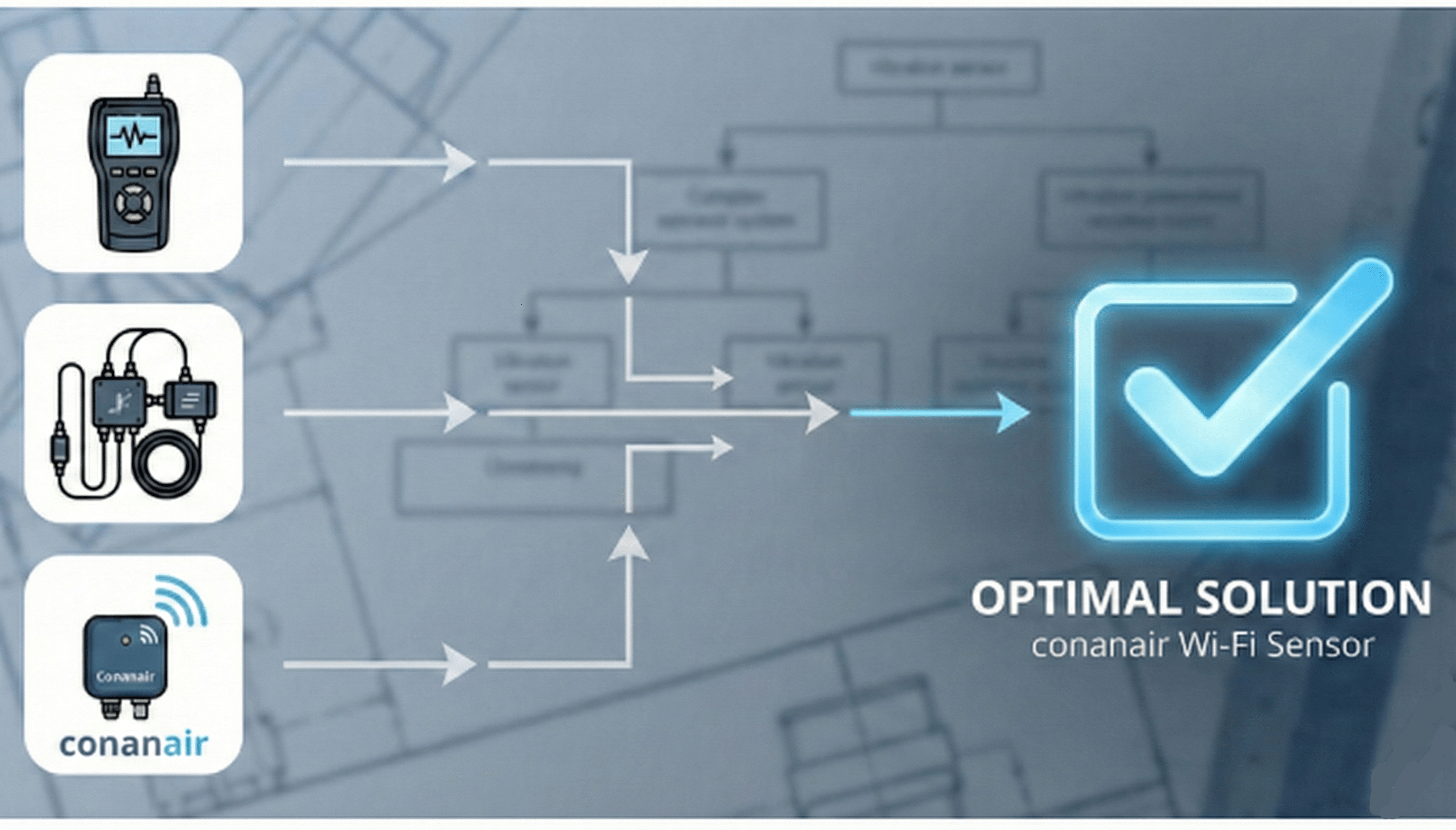
[Conclusion] The key is to match the sensor type to the equipment's criticality, the difficulty of manual inspection, and your need for detailed analysis. Use wired sensors for "Critical Assets" where a momentary stop is unacceptable, and handheld meters for "Secondary/Standby Units" that only need occasional checks. However, for "Primary Rotating Machinery (e.g., pumps, fans)" where you want to automate manual inspections without expensive wiring, choosing a low-cost Wi-Fi wireless sensor that can capture raw waveforms (FFT) will maximize your Return on Investment (ROI).
Thinking about starting vibration monitoring but not sure which method is best? Simply follow our YES/NO diagnostic flow to find the ideal solution for your environment and goals.
Which One is Best for Your Site? Diagnostic Flow
Step 1
Is the target "Critical Safety Equipment"?
(e.g., Turbines where failure causes major accidents)
Vibration Sensor Categorization by Asset Criticality
Implementing expensive wired sensors for every piece of equipment is not always practical. Using wired systems for "Critical Assets" that cannot stop for even a second, and wireless (conanair) for "General Assets" that were previously handled by manual inspections, maximizes your Return on Investment (ROI).
Equipment Class
Recommended Monitoring Method
conanair (Wi-Fi) Application
Critical Assets (Turbines, Large Generators, etc.)
Secondary/Standby Units (Auxiliary Pumps, Exhaust Fans, etc.)
Manual Inspection / Spot Checks Equipment measured only when signs of failure appear.
【Compatible】 A single sensor can be used for "portable measurement," covering up to 100 points.
Comparison of Method Benefits and Drawbacks
[A] Wired Continuous Monitoring Systems
Used for the heart of power plants and oil refineries, where even a momentary stop is unacceptable.
Pros: Highest reliability. Can trigger automatic emergency shutdowns in real-time.
Cons: Costly (thousands of dollars per point). Massive wiring installation costs make it difficult to justify for standard pumps and fans.
[B] Portable Vibration Meters (Handheld)
The most common method where maintenance personnel visit the site to take periodic readings.
Pros: ・A single meter can measure many points. ・Wide choice of devices, from low-cost basic diagnosis to high-end precision diagnostic tools.
Cons:? ・High labor costs for manual measurement. Data varies by operator. Dangerous locations (high or near rotating parts) cannot be measured.
[C] conanair (Wi-Fi Vibration Sensor)
A new choice that combines "wired-level analysis" with "handheld-level ease of use."
Pros: ・No wiring required (battery-powered, direct Wi-Fi). ・Provides "Raw Waveform Data (FFT)" comparable to wired systems at handheld prices. ・Automated measurement solves labor shortages.
Cons: Frequent measurements require battery replacement (every few months to years). Not suitable for real-time emergency shutdown.
Specific Applications Where conanair Excels
conanair is specialized in transitioning general-purpose equipment?which previously relied on human "sensory" inspections?to low-cost digital predictive maintenance.
HVAC Fans and Cooling Towers: Remote monitoring in high or outdoor locations where wiring is difficult.
Cooling Water and Circulation Pumps: Early detection of bearing damage using acceleration data before audible noise occurs.
Conveyor Drive Motors: Trend management to prevent sudden line stops in manufacturing plants.
Wastewater Treatment Submersible Pumps: Reduce inspection frequency and implement CBM (Condition-Based Maintenance).
Where conanair is the "Perfect Fit"
Based on our diagnosis, conanair provides overwhelming performance in these specific site conditions:
Sites where wiring installation quotes were too high to proceed → Magnetic mounting and battery operation mean zero installation costs.
Sites with dangerous or hard-to-reach locations → Once installed, data can be collected via Wi-Fi from the safety of your office.
Maintenance engineers who want detailed root-cause analysis → While many simple sensors only provide "numerical values," conanair provides "raw waveforms," enabling precision diagnosis (FFT analysis).
The Importance of a "Small Start" to Prevent Project Failure
Many failures in implementing predictive maintenance systems stem from attempting to build a large-scale network or an expensive cloud system covering the entire factory from the very beginning. To avoid the project being deemed "not cost-effective (poor ROI)" because the initial investment couldn't be recovered, the golden rule is to start small and verify the effectiveness.
Do not implement company-wide right away; start Proof of Concept (PoC) with 1 or 2 units on "frequently failing equipment."
Fully utilize free loaner units to pre-test and ensure Wi-Fi signals reliably reach even in harsh factory environments.
Minimize initial costs by using commercially available Wi-Fi routers and existing PCs instead of purchasing expensive dedicated receivers (gateways).
A Practical Solution to Accelerate Maintenance DX
conanair’s greatest strength is its ability to overcome the exorbitant initial costs of wired systems and the labor-intensive, inconsistent nature of handheld inspections, all while providing the "raw waveform data (FFT analysis)" that typical wireless sensors cannot. By meeting the strict demands of the field?"We want to start small with low costs, but we don't want to compromise on precision diagnostics"?conanair strongly supports risk-free IoT implementation and the digital transformation (DX) of equipment maintenance. For a detailed spec comparison with other products, please refer to the following page.



 How should I choose between wired, handheld, and wireless (Wi-Fi) vibration sensors for my facility to avoid making a mistake?

 Why Pros Choose conanair: A Thorough Comparison