




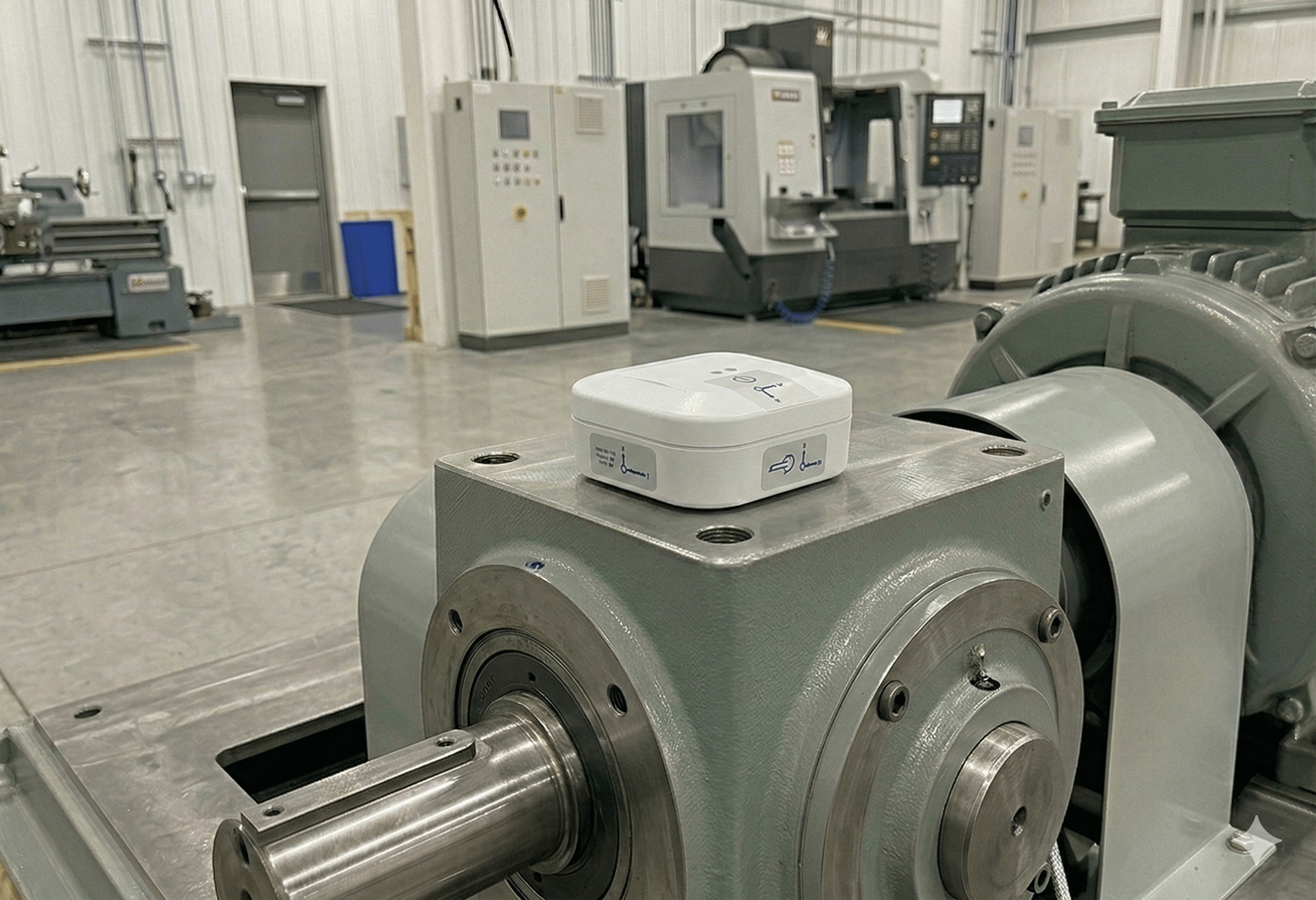

Bearing damage is one of the leading causes of failure in rotating machinery. On-site, it is not uncommon to wonder whether to monitor "velocity" or "acceleration," or how to apply absolute values such as ISO standards. For bearing anomaly detection, it is important to combine the monitoring of changes from the normal state using vibration velocity RMS with the confirmation of impact vibrations using acceleration data. This article explains everything from the basic concepts of bearing anomaly detection using conanair to clues for precision diagnosis via FFT analysis using raw data.
If you want to analyze conanair measurement data (CSV/CNA files) immediately, please use our free web app that runs directly in your browser with no installation required. (*To ensure confidentiality, no data is transmitted to external servers.)
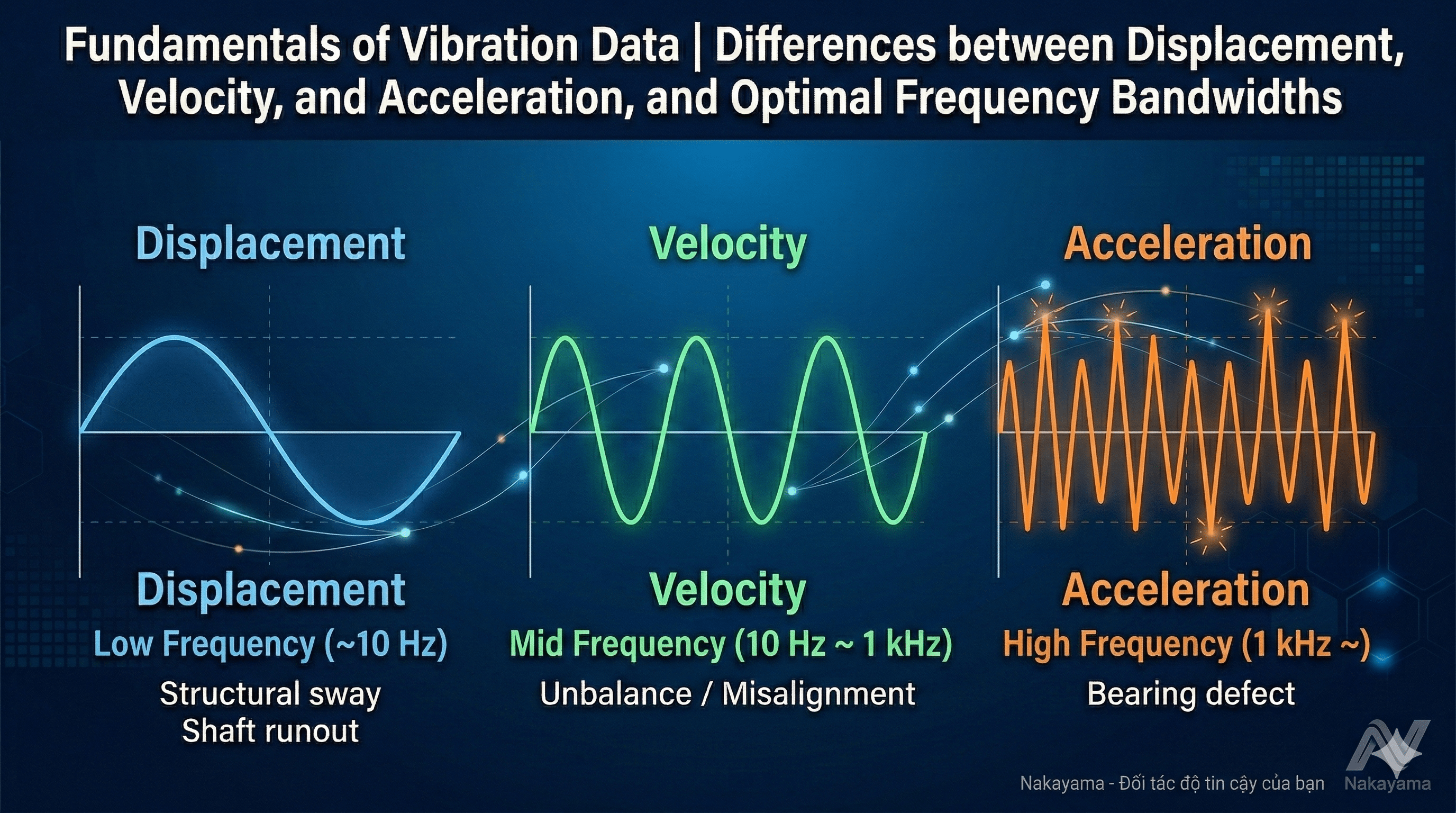
As a fundamental aspect of vibration data, "displacement, velocity, and acceleration" each have specific frequency bands they excel at measuring. (For detailed differences between each metric, please also refer to the "Basic Knowledge of Vibration Data" page.)
Relatively low-frequency abnormalities caused by rotation, such as unbalance and misalignment, appear significantly in "velocity." As an indicator for grasping the overall vibration magnitude of the equipment, using velocity RMS is the standard for daily "trend management" (monitoring whether it differs from the usual state).

On the other hand, if the raceway or rolling elements of a bearing are scratched, the initial stage lacks the energy to shake the entire structure significantly and instead appears as a high-frequency impact where metals collide. It is "acceleration" that sharply captures this high-frequency impact. The practical approach is to perform daily trend management using velocity, and if signs of an abnormality are seen, analyze the raw acceleration data (waveform) to estimate the bearing damage. Also, the sensor installation direction is important for acquiring accurate data. (For details, please see the "Correct Installation Direction for Vibration Sensors" page.)
When starting vibration monitoring, many sites refer to "absolute value standards" such as ISO 10816 and ISO 20816. However, these standards have specific scopes of application, and actual equipment will have completely different normal vibration values depending on the installation environment and foundation rigidity.
Rather than determining abnormalities based solely on absolute numerical values, "trend management"?which uses the vibration value during normal operation (baseline) as a reference and continuously monitors changes from it?is extremely effective for capturing signs of abnormalities for each specific piece of equipment. Criteria for caution and warning are set individually based on the characteristics and operating conditions of each facility. Initially, it is common practice to set the caution level at about twice the normal vibration value, and the warning level at 4 to 5 times, revising them according to the situation. Because conanair supports both cloud and cloudless (local) environments and is easy to retrofit, it is highly suitable for trend management that accumulates long-term data and establishes criteria for each piece of equipment.
Once signs of an abnormality are captured through an increase in velocity RMS, the next step is to perform a precision diagnosis (FFT frequency analysis) to estimate the cause.
conanair employs a patented technology (Patent No. 6951474 "Under-sampling") that intentionally limits the effect of the anti-aliasing filter. This utilizes the aliasing phenomenon to provide clues for analyzing high-frequency impact vibration components that are difficult to handle with normal sampling. Because the acquired raw vibration waveforms can be freely utilized, analysis such as precision diagnosis and the application of AI are possible. (For the technical principles and mechanisms, please also refer to the "What is Patented Undersampling? Differences from Bearing Diagnosis (Envelope FFT)" page.)
By applying envelope processing to the acquired raw vibration waveform and then performing an FFT analysis (Envelope FFT), and checking if a characteristic peak appears near a specific frequency calculated in advance, you can obtain important clues to estimate the cause of the abnormality.
Note that with initial bearing damage, the characteristics may not appear clearly. Sometimes peak vibrations appear temporarily and then disappear.
However, you cannot always completely identify the cause of the abnormality solely from frequency peaks. If vibrations appear in a frequency band where they previously did not exist, it can be predicted that some kind of abnormality is present, but a comprehensive judgment considering the equipment's operating state and measurement conditions is necessary.
As mentioned above, to allow anyone to easily analyze the raw data files acquired with conanair, we offer a dedicated FFT analysis application that runs entirely on a web browser for free. No troublesome software installation is required; simply drag and drop the data file (CSV or CNA file) saved on your computer into the graph area of the app screen, and the waveform and frequency components (FFT) will be displayed instantly.
 Analyze conanair Measurement Data | Free FFT Analysis App
It is also possible to select and load a file using the "Dataset: Pick a local File" button at the bottom of the screen. All processing is completed within your device (browser), and no data is transmitted to an external server. You can safely analyze even highly confidential factory data.
The accuracy of bearing anomaly detection is improved by combining "trend management (early detection)" using velocity with "FFT analysis (cause estimation)" using acceleration and raw data. Please utilize conanair and our analysis app to build a quantitative and practical predictive maintenance system.
| Company Name | NSXe Co.Ltd - Nakayama Hydrothermal Industry Co., Ltd. |
|---|---|
| Head Office | 7686-10 Hirano-cho, Suzuka, Mie513-0835, Japan zip code 513-0835 |
| Phone | +81-90-2189-1398 |
| FAX | +81-59-379-4704 |
| Business Hours | 8:00~17:00 |
| Office Regular Holiday |
Saturday afternoons, Sundays and public holidays |
| URL | https://conanair.com/ |
| Company Name | NSXe Co.Ltd - Nakayama Hydrothermal Industry Co., Ltd. |
|---|---|
| Head Office | 7686-10 Hirano-cho, Suzuka, Mie513-0835, Japan zip code 513-0835 |
| TEL | +81-90-2189-1398 |
| FAX | +81-59-379-4704 |
| Business Hours | 8:00~17:00 |
| Office Regular Holiday |
Saturday afternoons, Sundays and public holidays |
| URL | https://conanair.com/ |