


 How can we safely monitor the vibration of high-altitude equipment like cooling towers?



[Conclusion] The most effective method is retrofitting a "fully wireless, battery-operated vibration sensor" that requires no wiring or power supply, allowing remote trend management via a PC. High-altitude inspections on roofs or outdoors always involve the occupational hazard of falling. By introducing conanair, which collects data remotely via Wi-Fi from a safe location, you can eliminate dangerous routine inspections while accurately detecting fan unbalance and early bearing anomalies.
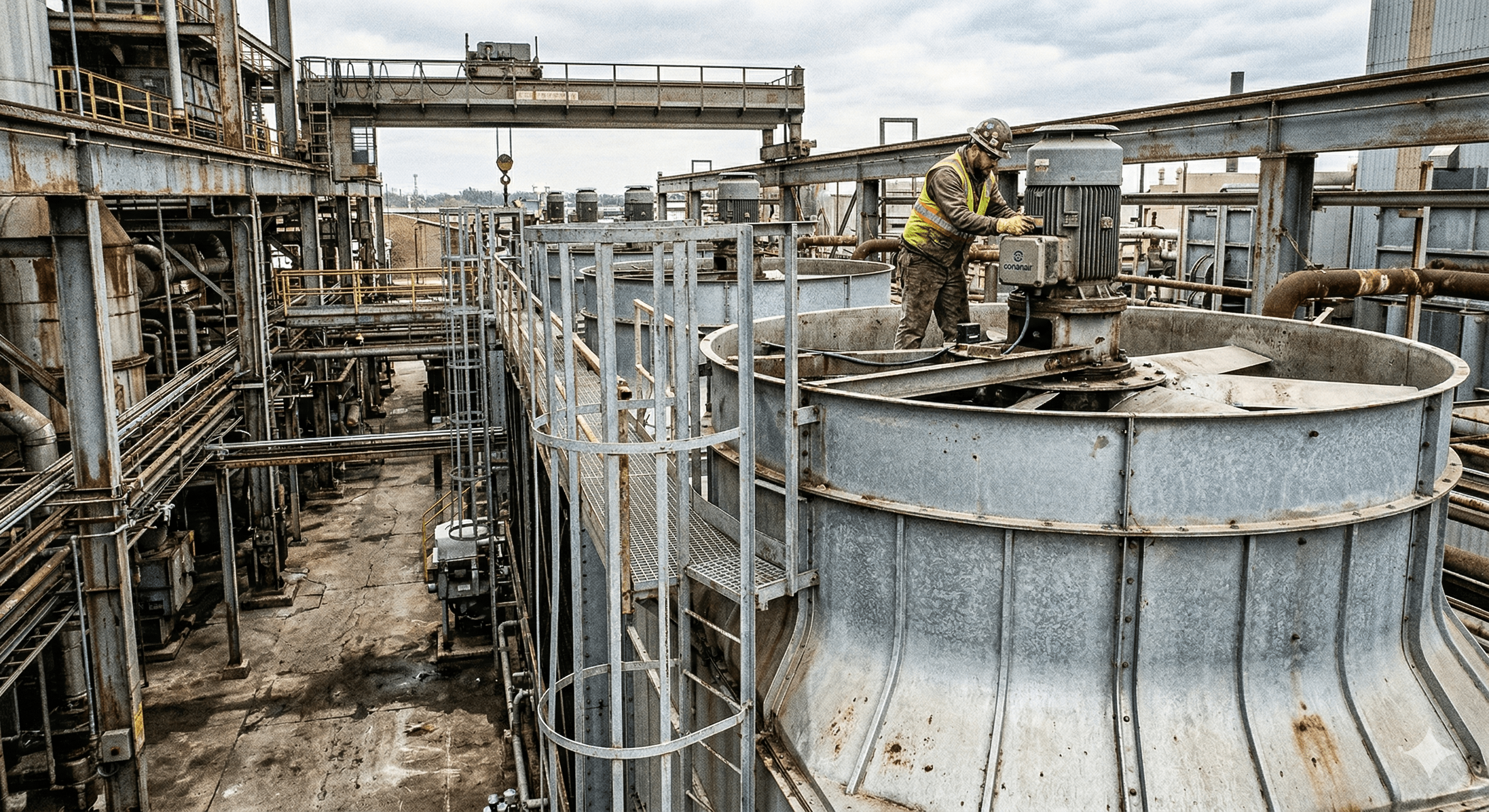
Fans in cooling towers, motors for overhead cranes, or equipment enclosed in narrow spaces or soundproof covers. These are prime examples of "harsh environments" where maintenance engineers must climb ladders and perform regular patrol inspections at their own risk.
These high and dangerous places are exactly where the need for predictive maintenance with automated data collection is highest. However, attempting to introduce "wired vibration sensors" here incurs "scaffolding costs" and "long-distance cable laying costs" that are many times the price of the sensors themselves, causing the project to stall due to a poor return on investment.
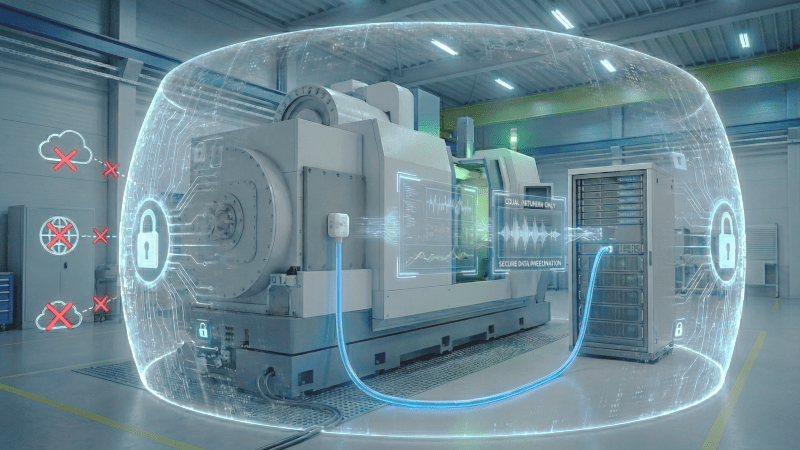
conanair is "fully wireless (Wi-Fi + battery operated)," requiring neither communication cables nor power cables.
Scaffolding is only needed during the initial "sensor installation" and for "battery replacement" once every few years (*conanair's long-life design allows for continuous operation from several years up to 10 years depending on the measurement frequency). This dramatically lowers the installation cost and the danger of inspections, making constant monitoring of high-altitude equipment—previously given up on—a reality.
Here, we will honestly discuss the "radio wave constraints" that are absolutely unavoidable when introducing a fully wireless system.
There is no magic that says, "Because it's fully wireless, it will easily connect anywhere." Inside a factory full of iron, behind thick concrete walls, or inside metal soundproof covers are harsh environments where Wi-Fi radio waves have extreme difficulty traveling (they attenuate easily).
Realistic Approaches to Radio Wave Constraints
We don't talk about idealistic "catalog communication distances." We face the physical constraints of the site's radio wave environment and support realistic network designs to ensure data is delivered reliably.
In the implementation of wired sensors, the "construction cost" often becomes a bigger bottleneck than the price of the sensor itself. Especially in high places, explosion-proof areas, or underground pits, it can cost thousands of dollars just to run a few meters of wiring. Fully wireless conanair makes predictive maintenance possible for equipment previously neglected due to "unjustifiable costs" by bringing infrastructure construction expenses close to zero.
By replacing dangerous manual inspections of high-altitude and hard-to-reach equipment with conanair's wireless automated monitoring, facilities can dramatically improve worker safety and operational efficiency. Overcoming the physical constraints of traditional wired sensors allows you to build a comprehensive predictive maintenance system that covers the entire plant without exorbitant installation costs.
| Company Name | NSXe Co.Ltd - Nakayama Hydrothermal Industry Co., Ltd. |
|---|---|
| Head Office | 7686-10 Hirano-cho, Suzuka, Mie513-0835, Japan zip code 513-0835 |
| Phone | +81-90-2189-1398 |
| FAX | +81-59-379-4704 |
| Business Hours | 8:00~17:00 |
| Office Regular Holiday |
Saturday afternoons, Sundays and public holidays |
| URL | https://conanair.com/ |
| Company Name | NSXe Co.Ltd - Nakayama Hydrothermal Industry Co., Ltd. |
|---|---|
| Head Office | 7686-10 Hirano-cho, Suzuka, Mie513-0835, Japan zip code 513-0835 |
| TEL | +81-90-2189-1398 |
| FAX | +81-59-379-4704 |
| Business Hours | 8:00~17:00 |
| Office Regular Holiday |
Saturday afternoons, Sundays and public holidays |
| URL | https://conanair.com/ |