

 What is the decisive difference between edge processing and raw data storage?



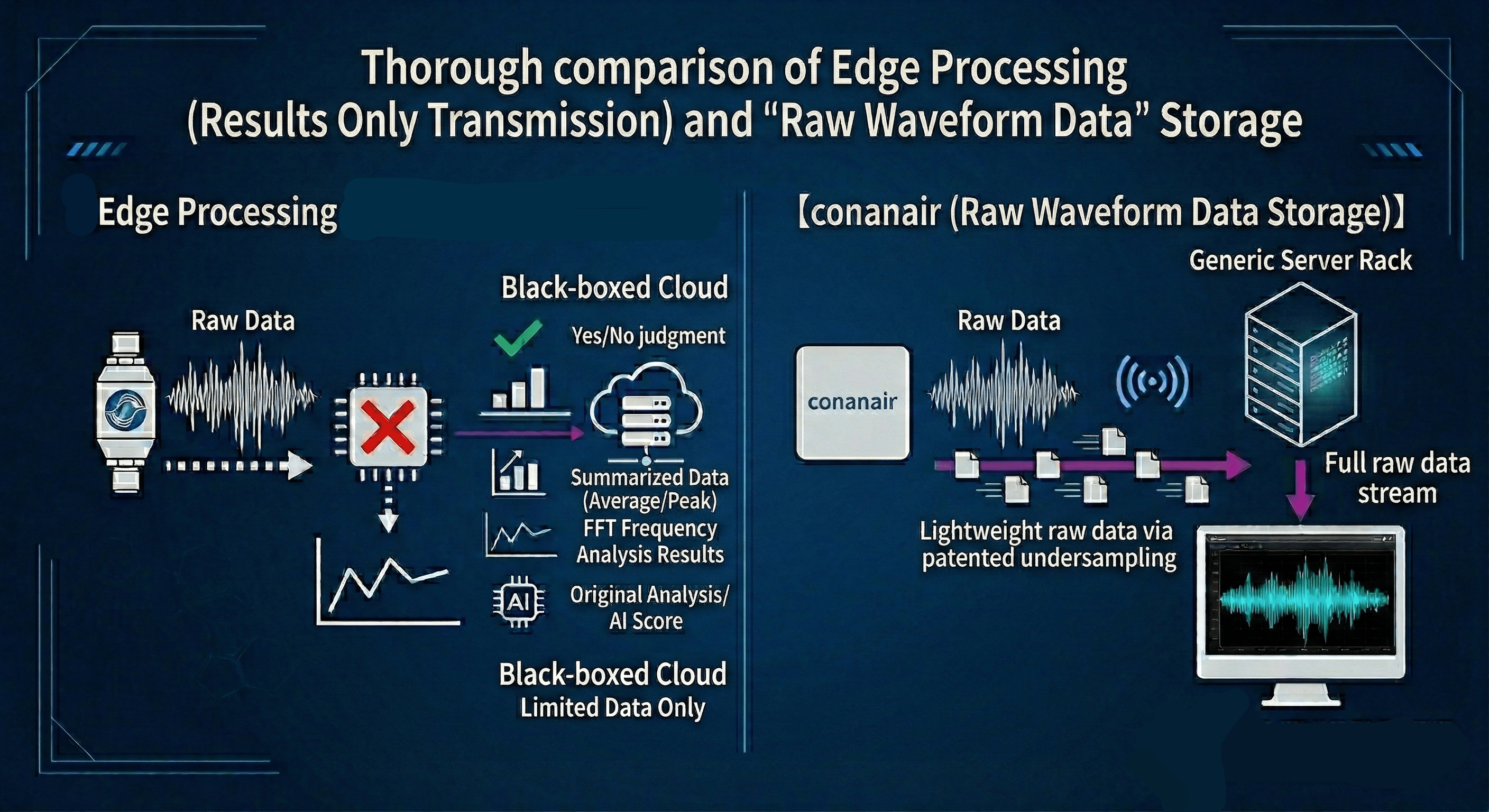
[Conclusion] The biggest difference is the "ability to perform post-verification (avoiding a black box)." Edge processing prioritizes reducing communication data and only transmits results (such as alerts), making it impossible for experts to verify the data later. On the other hand, conanair, which stores raw waveform data lightened by patented technology, allows engineers to review the waveforms, re-run FFT analysis, and accurately identify the root cause of anomalies.
When considering a predictive maintenance system using IoT, a specification even more important than the sensor's catalog specs is "what format the data is transmitted and stored in."
Most mainstream wireless vibration sensors today employ "edge processing" to minimize communication volume and power consumption. However, this very edge processing is the root cause of the "black box" effect that plagues maintenance engineers in the field.
In this article, we explain the specific contents of edge processing and the decisive difference from the "Raw Data" preservation that the wireless vibration meter "conanair" insists upon.
The phrase "performing edge processing on the sensor side" sounds like advanced technology, but the "results" actually transmitted to the cloud or server generally include the following types of information:
Main data transmitted by edge processing (Specific examples)
All of these are "processed results." Since the amount of transmitted data is overwhelmingly small, system construction becomes easy. However, is a "result" all that is truly needed at the site of predictive maintenance?
The biggest disadvantage of edge processing is that the "Raw Waveform Data," which contains the most information, is discarded at the sensor side.
When an alert sounds to notify an anomaly, engineers in the field will invariably want to confirm: "Why was that judgment made?"
"Was it just picking up a sudden burst of noise?"
"Are the periodic peaks characteristic of bearing damage actually appearing?"
In an edge processing system, since the original waveform does not exist, these questions cannot be answered. It is impossible for the engineer to later re-perform FFT analysis for verification. As a result, they fall into a black box where they have no choice but to trust the system's judgment while remaining skeptical.
Recently, highly advanced anomaly detection using AI has gained attention in the manufacturing industry. However, systems that only save "results" via edge processing cannot support the future evolution of AI.
To improve an AI's judgment accuracy, it is essential to train it with large amounts of "raw waveform data" from both normal and abnormal states. If the waveforms are discarded at the edge, it becomes impossible to perform flexible improvements later, such as "re-training past data with a new algorithm." This leaves users trapped by the fixed AI provided by a specific manufacturer (vendor lock-in).
The "weapon" for field engineers to make maintenance decisions with confidence is unprocessed raw waveform data. However, a major technical dilemma exists here.
Normally, to acquire high-frequency vibrations indicating bearing anomalies as "raw waveforms," the sampling rate must be set very high, resulting in an enormous data volume. This volume strains wireless communication bandwidth (such as Wi-Fi) and rapidly consumes the sensor's battery, making practical operation difficult.
"We want to keep the raw data. But the data volume is too large for wireless operation."
Conanair developed the patented "Under-sampling technology" to resolve this contradiction and continue saving "lightweight raw data" while dramatically reducing communication volume.
By moving away from black-box edge processing and embracing raw data storage, conanair empowers field engineers to take full control of equipment diagnostics. This transparency ensures that maintenance teams are not left guessing when an alert occurs, providing the exact waveform data needed to make confident, evidence-based decisions.
| Company Name | NSXe Co.Ltd - Nakayama Hydrothermal Industry Co., Ltd. |
|---|---|
| Head Office | 7686-10 Hirano-cho, Suzuka, Mie513-0835, Japan zip code 513-0835 |
| Phone | +81-90-2189-1398 |
| FAX | +81-59-379-4704 |
| Business Hours | 8:00~17:00 |
| Office Regular Holiday |
Saturday afternoons, Sundays and public holidays |
| URL | https://conanair.com/ |
| Company Name | NSXe Co.Ltd - Nakayama Hydrothermal Industry Co., Ltd. |
|---|---|
| Head Office | 7686-10 Hirano-cho, Suzuka, Mie513-0835, Japan zip code 513-0835 |
| TEL | +81-90-2189-1398 |
| FAX | +81-59-379-4704 |
| Business Hours | 8:00~17:00 |
| Office Regular Holiday |
Saturday afternoons, Sundays and public holidays |
| URL | https://conanair.com/ |