

What is the decisive difference between edge processing and raw data storage?[Conclusion] The biggest difference is the "ability to perform post-veri...
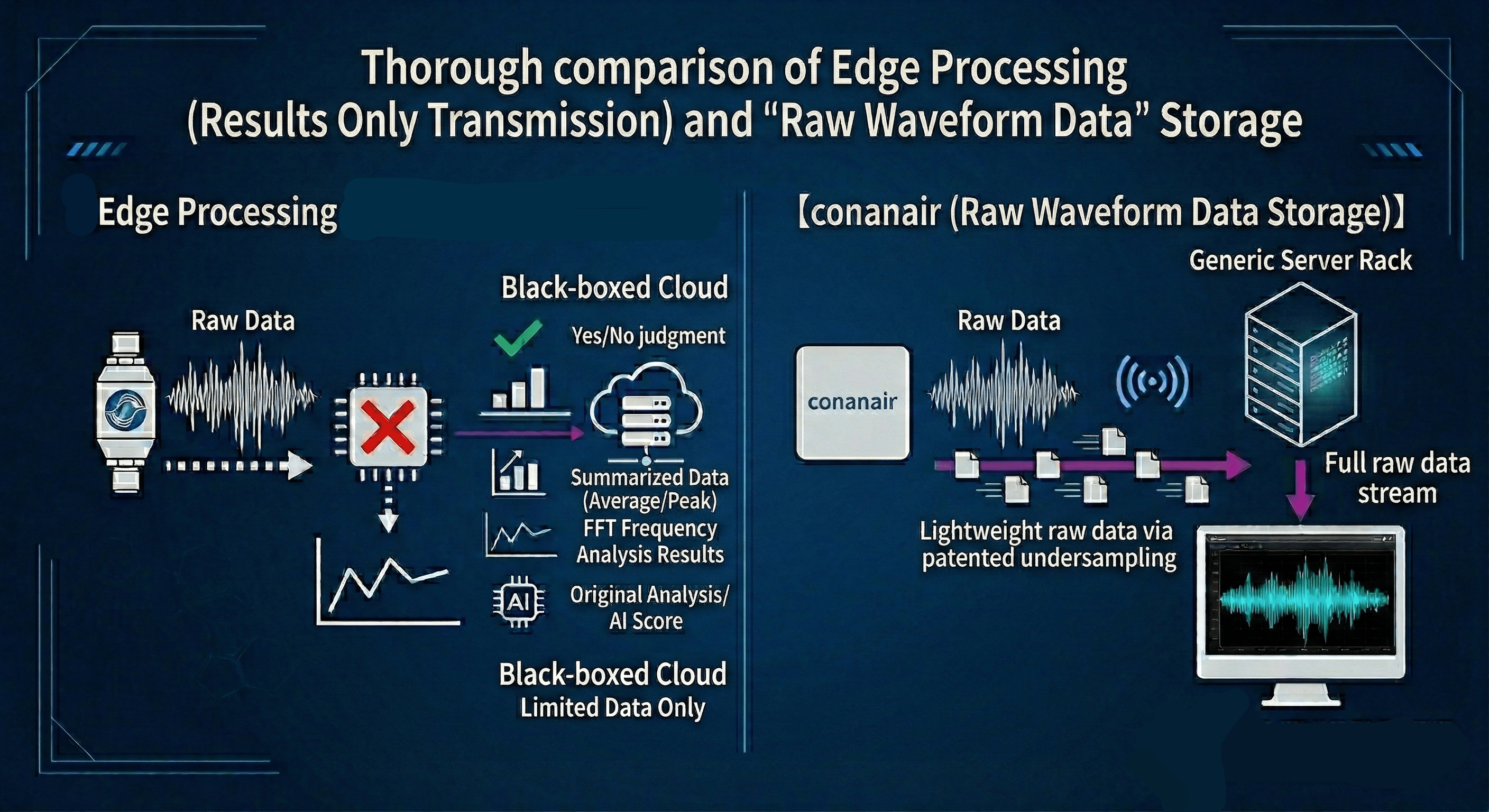

In the world of IoT vibration sensors, "convenience" often comes at the cost of "transparency." Many modern systems rely on edge processing or black-boxed AI scores, which can leave maintenance engineers unable to verify why an anomaly was detected. In this category, we pull back the curtain on vibration analysis algorithms, advocating for the preservation of raw data and explaining the sophisticated technology that makes high-precision diagnostics affordable.
To achieve true predictive maintenance, it is essential to distinguish between a simple "judgment score" and verifiable "engineering facts." We examine the fundamental requirements for equipment monitoring, comparing the limitations of edge-only processing against the long-term benefits of raw data storage. By saving raw waveforms, engineers can perform follow-up FFT analysis and prevent the "black box" effect where critical maintenance decisions are made by an unverified algorithm. We believe that raw vibration data is an asset that belongs to the factory, and its accessibility is the foundation of reliable machinery diagnostics.
Innovation in vibration monitoring is driven by our patented "under-sampling" technology, which enables high-frequency bearing diagnosis using low-cost hardware. We provide a transparent technical explanation of this mechanism, which intentionally utilizes aliasing to capture high-frequency impacts. Crucially, we also clarify the clear technical limits of this approach, such as the impossibility of precise absolute value measurement in high-frequency bands. By understanding both the strengths and the constraints of our technology, engineers can leverage raw CSV exports and Python integration to build advanced, proprietary analysis environments that surpass the capabilities of expensive, closed-box systems.